

The real promise of AI glasses isn’t convenience
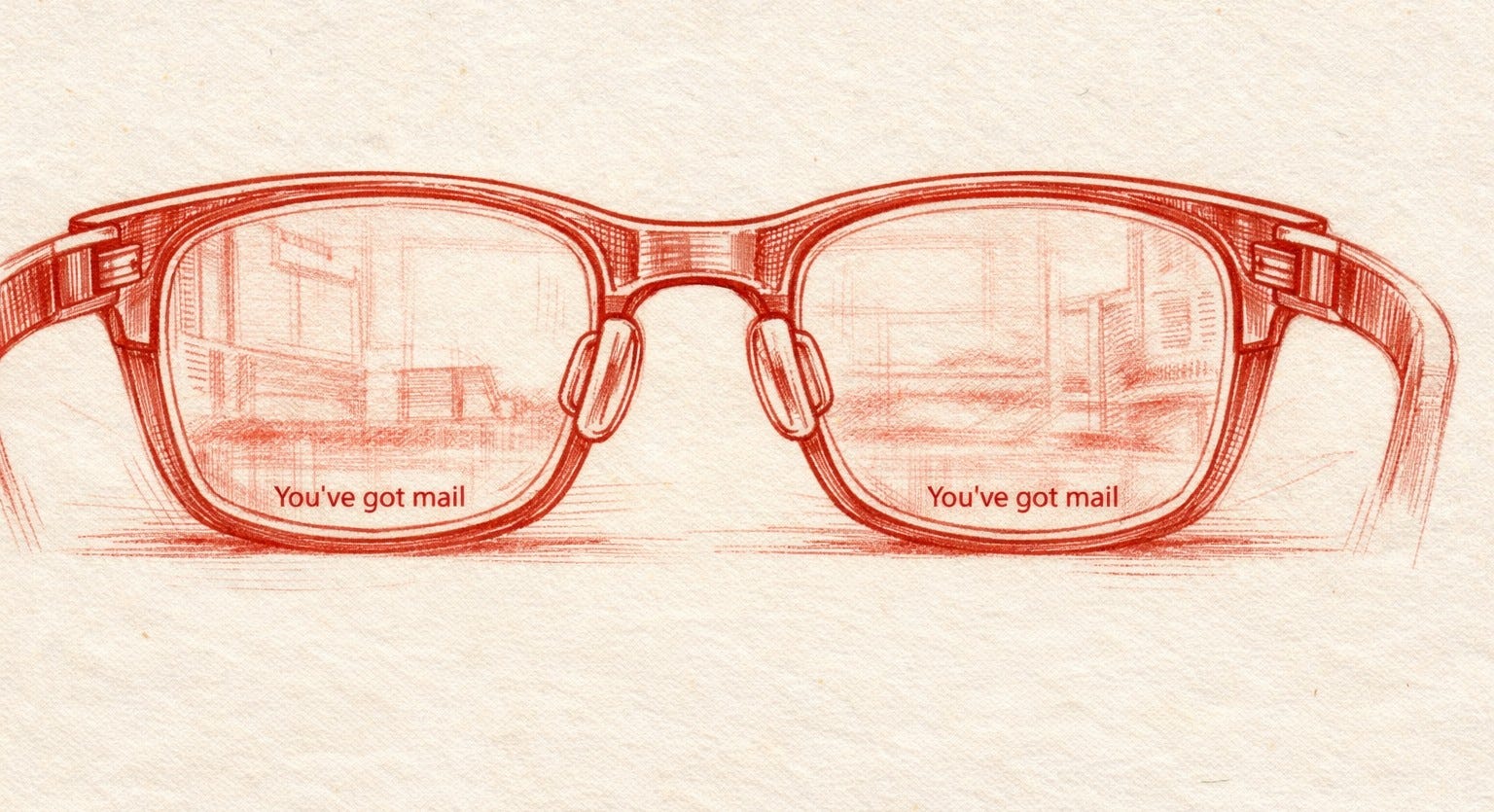
The promise of always-available assistance

I’ve had the Meta Ray Ban glasses for about a year, but I still haven’t worn them.
I thought they’d be cool to try out, but I haven’t: getting numbered photochromatic lenses on them is expensive and I’m at an age where I’ll probably soon need progressives for reading.
Two, apart from WhatsApp, I’m quite vary of Meta products, the profiling and the data collection. The other side of Zuckerberg’s Carthago delenda est philosophy is that there’s a lot of collateral damage in terms of user rights, because winning is everything, and user rights appear to be an afterthought when you move fast and break things.
Three: even though I want to try them out, I don’t really fully understand the utility for me. Yes it can do things, and the new glasses (even more expensive) appear to be even better because they’re visual and not just audio, but do I really need to set this up?
There’s a proliferation of AI enabled glasses now: Sarvam just launched Kaze at the AI Summit, Jio too, and Peyush Bansal has been going around promoting AI glasses called “B” by Lenskart. That’s a thoughtlessly chosen name, given how often someone says “be” in a conversation. Snap, a pioneer in wearables, has recently created a subsidiary to focus on the segment. This is cool to have but do people want yet another another thing to charge? Wouldn’t I rather type quietly when I’m in company than speak to my glasses?
When Ben Thompson wrote about Snapchat’s glasses in 2016, he identified problems with the Google Glass:
“Glass was a failure for all the obvious reasons: they were extremely expensive and hard to use, and they were ugly not just aesthetically but also in their ignorance of societal conventions.”
“These problems, though, paled in the face of a much more fundamental issue: what was the point?”
“Oh sure, the theoretical utility of Glass was easy to articulate: see information on the go, easily capture interesting events without pulling out your phone, and ask and answer questions without fumbling around with a touch screen. The issue with the theory was the same one that plagued initial smartphones: none of these use cases were established, and there was no ecosystem to plug into.”
A product must typically address three constraints: a product-market fit, user trust, and become a habit. As I’ve written previously, Meta failed to dominate the smartphone, so it’s not unexpected that they’re positioning the wearable almost as the “anti-phone”. In September 2025, while announcing the new AI Glasses, they introduced the Display saying:
“With a quick glance at the in-lens display, you can accomplish everyday tasks—like checking messages, previewing photos, and collaborating with visual Meta AI prompts — all without needing to pull out your phone”…”It’s technology that keeps you tuned in to the world around you, not distracted from it”…”it isn’t on constantly — it’s designed for short interactions that you’re always in control of. This isn’t about strapping a phone to your face. It’s about helping you quickly accomplish some of your everyday tasks without breaking your flow.”
It’s odd to see a company that is built around enabling addiction and engagement, pitching a product as if it’s as unnecessary and ephemeral, and largely an add-on, like a smartwatch. It almost feels like it’s a product that is searching for a default use case, and it doesn’t quite know what its core value proposition is.
It turns out there is value in wearable AI beyond the “check your messages” use case.
Where AI is a lifeline
Sometime last year, I helped Arun Mehta, who works in accessibility tech, with prompting for an app that allows people who can’t move much (eventually not at all), or speak, communicate by picking one word at a time, using whatever faculty is available to them: essentially address the verbal diarrhea that LLMs subject us to, and the idiocy when they display many words when all you’ve asked for is a single highly probabilistic output. I’m mostly talking about GPT 5.2, but the others do this too. For someone who can’t communicate, the the ability to pick word at a time, is a critical means of communication.
At the AI Summit in India, Agustya Mehta, Director of Hardware Engineering, changed the way I look at wearables: by calling it an always-available assistance; not “convenience” like a smartwatch, but a source of freedom, independence and avoidance of exclusion from what many of us take for granted. The insight from Mehta that changed the way I look at things:
Mehta highlighted Ray Kurzweil’s development of the MP3 in in partnership with Bell Labs in the 1970s, as “designed to create books for people who were blind”, and his “text-to-speech synthesis,” and optical character recognition as examples of technology built for accessibilty that is currently being used by everyone. I can’t watch a movie without subtitles anymore, he said, and that’s true for me too.
“So, while it might seem like developing an interface for someone who cannot see may be a niche use case, it’s actually front and center for innovation. It’s also good core design for everybody.”
While we still don’t know the default use case for Glasses AI, but perhaps once it is useful enough for those who need it, it becomes useful enough for everyone: assistance stops becoming “assistant” the moment it becomes the easiest way to understand what’s going on. It becomes default.
The friction that Glasses AI collapses
Those with accessiblity issues typically get human assistants, or an assistive dog, Mehta pointed out. While human assistants are not easy to come by, not everyone wants a dog or can handle one. There aren’t also enough guide dogs in the world. Assistance, even digitally with subtitles, translation and closed captioning, isn’t scalable until AI came to wearables. AI converts assistance from a special scarce arrangement to a default.
Mehta pointed out that through its partnership with Be My Eyes, “anyone around the world can now get assistance in less than seconds. Something that might take a blind person 20 minutes, because they just drop their pen or their mail, can be solved in 30 seconds.”
That scalability brings in quiet, always available, in-context help. The fact that a live assistant “can truly answer the questions we’ve been having as long as there’s no prompt in front of us. It’s like having a buddy with you at all times who can help you give live translation to something that everyone can benefit from”, changes AI from a feature, or an app you open on your phone, to presence that can be called immediately when you need it. This is what makes AI glasses more than just a smart watch in front of you eyes, just for notifications or calling.
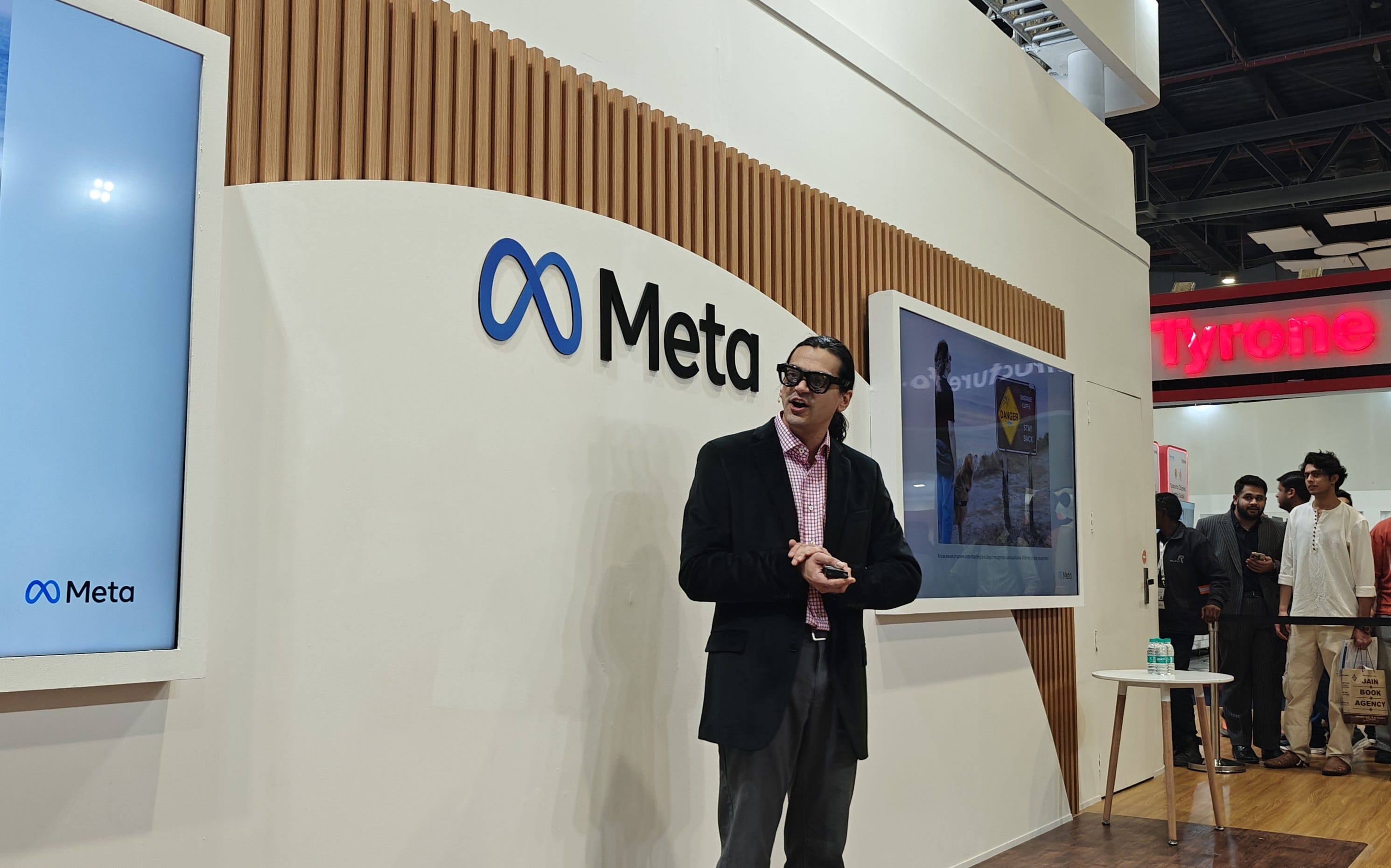
The other utility that Mehta mentioned might work really well for older people who are losing their hearing: They have a feature that simply amplifies sounds, and becomes a default for conversations. Glasses would also look less evident than a hearing aid. It has the ability to do more, halfway to an agent:
“Features that can remind you of things, so you never lose your wallet, so that you don’t drop the ball when your prom is due Sunday.”
There are other use cases that I had noted down when I wrote about Meta’s acquisition of Manus, but not published (because that piece became very long):
Manus can act as the “brains” behind Meta’s wearables (Ray‑Ban Meta glasses, future pendants, Quest, etc.), turning them into autonomous and proactive assistants that see, hear, and act for the user across Meta’s apps and the wider web.
Manus could also coordinate actions for the user across devices, say between the glasses, the phone and a PC, in terms of capture something the user looks at, research it in the background and send a message or provide information to the user without the need for the user to do something.
It can create automatic summaries for users, across information from their WhatsApp groups, handle their calendar and appointments, draft follow up messages and mails, maintain a to-do list, and so much more
Give it a few years, and Manus could probably create utilities for the user, on the fly, depending on actions and anticipated actions.
While the current workflow is for managing information and providing context, a fully integrated Manus would work as an execution layer within the Meta wearables ecosystem. If agents are making lives easier for those without accessibilty challenges, the delta of the impact will be far more significant for those who have so far not been able to leverage digital tools as effectively as the rest of us.
AI in glasses can move things from accessiblity to enablement.
The Social Friction that Glasses AI faces
“You’re not recording me, are you?” is a question I ask half in jest, everyone I see wearing smart glasses. It’s like having CCTV’s, not on every street, but on every person. A doctor today assumes that their patient is recording their consultation, even if it is without consent.
I can’t imagine how horrifying the idea of glasses that can record at any time will be, especially for women, and it will change irreversibly, how we interact with each other. From the BBC:
Oonagh says she was filmed by a man using smart glasses, which have inbuilt cameras, without her knowledge or consent. The video was then posted on social media, getting about a million views and hundreds of comments - many of them sexually explicit and derogatory.
“I had no idea it was happening to me, I didn’t consent to that being posted, I didn’t consent to being secretly filmed,” Oonagh said.“It really freaked me out - it made me feel afraid to go out in public.”
What makes glasses different from phones is that the recording being on is hard to see, and the person being recorded may only find out after the upload, or not at all. Add nudify apps to the mix and there’s a disaster around every corner.
While Meta may have solved the problem that Google Glass faced, by adding a blinking red light around the camera, it’s also true that that isn’t a regulatory requirement, and not every company will follow that. The BBC points out that there are mechanisms for disabling this as well. In a wider setting, just as with phone cameras, you never know when you’re being filmed. Add zoom, and the problem compounds.
AI that sees for us can also capture us without our consent. Legally, there’s isn’t much that protects us:
She reported the incident to Sussex Police, but was told there was nothing they could do, as it is not illegal to film people in public.
This problem isn’t just limited to the UK: India’s Digital Personal Data Protection Law states publicly available personal data is outside the ambit of data protection.
As with every technology, countermeasures get invented, but I’ll be honest: it sucks that the cost of defense is constantly externalised to users who might be at risk by technology companies. Google Glass is a clear example of irresponsible deployment without adequate protections.
On top of this, Meta is now planning to add facial recognition to the glasses: useful for those with disability, but not for those who don’t want to be identified. In fact, two Harvard students put facial recognition tech on Meta’s glasses, and showed how web search can be integrated for doxing them.
It’s hard to say whether the collapse of trust in public spaces us upon us yet, but it is certainly a threat, and while I completely buy Mehta’s point that the entire category cannot be reduced to “Creepy cameras”, the domain does have a creepy camera problem to solve.
Every new advancement of technology results in a new negotiation with acceptable social norms. I don’t mean to be fatalistic, but it’s just that we also appear to be at a point with AI where the negotiation has collapsed into muted acceptance. There will eventually be a backlash.
What else remains unresolved
Unlike some of my previous posts, this is commentary without actually experiencing the device. I think I’ll get those lenses for the glasses I’m yet to start using.
Some things still remain unresolved for AI glasses, however:
First, there’s a delegation gap in AI glasses. We’re not at a place where we can seamlessly delegate actions and cognitive load related to what we see or focus on, to the device in a way that without friction or misfires.
Second, the default use case is yet to be determined. That will only happen when you bring scale to usage, and glasses are very different from watches, and come with their own unique social pushback. Scale is neccessary for Meta here, and bringing price down and building social acceptance with the development of trust will be necessary.
Third, I’m not sure that a ‘tell me what I’m looking at’ as a starting point really works every time. How does a system know what to say when a user asks that. Too little information is dangerous, and too much can rener the entire process slow and overwhelming. With time and memory, this will get resolved, but an optimal starting point needs to be found.
Fourth, an autonomous mode needs to be considered too, if it isn’t already there. The need to talk to your glasses becomes tricky in some situations, and users perhaps need that switch between always on, and on only when invoked.
Fifth, how do we deal with errors here? The probabilistic nature of LLMs can be critical in some cases, and there are people for whom this cannot be left to chance.
Lastly, Thompson in his piece compared the initial Apple Watch, with a not-very-necessary use case for a smart watch with notifications, with a significant utility of something that captures and allows you to understand your health data. AI enabled glasses, as Mehta also acknowledged, needs to find a business use case that makes this viable.
While I understand Meta’s mass market focus, I do feel that there’s probably a need for a separate set of glasses for those with need for wider peripheral vision, especially in cases of visual disability, where reactions may not be instinctive and immediate, and people need anticipatory warnings (for example, about oncoming traffic).
I don’t mean to downplay the importance of AI enabled glasses as aid, but I wonder if we’ll get to a point where cameras we wear can substitute eyesight, what that point will be and what will it take for us to get there.
What I haven’t mentioned in this piece so far is that Mehta comes at this with personal experience: people in his family have a visual disability and his own number is very very high. He’s trying to make things better, and that came through in what he said and how he said it: there’s a genuine need and drive to make things better.
In that process, like with Kurzweil, we might end up with something worth having.