

When advertising comes to ChatGPT
Advertising belongs to whoever controls the moment of decision.

Where will all the advertising go if AI replaces search?
I wrote this as a single line note in my notebook on about five months ago. Basically, traffic to websites has been diminishing because of Google’s AI overviews/ AI Mode, and people turning towards tools like Perplexity for solutions instead of having to read page after page of SEO optimised content. They’re staying on platform and clicking out less.
Less traffic for publishers means lower ad inventory that can be served. All that advertising money has to go somewhere. Where does it go? YouTube? Instagram? X? But ads are not as simple as that: they don’t move platforms just like that.
The point at which their need is satisfied has moved from a website that users are directed to, to a platform that has the answers.
Google is already proving that advertising inside AI answers works. In recent earnings calls (Q1 and Q3 2025), Alphabet said that ads placed above, below, and even within AI Overviews are monetizing at approximately the same rate as traditional Search, even as those experiences scale to billions of users. In other words, AI answers are not collapsing advertising: they are reshaping where it appears.
ChatGPT has announced the launch of ads on its platform, for users on the free tier, and those on the Go plan paying $8 per month (Indian users currently are paying nothing for a year).
It is therefore important for us to understand how advertising on ChatGPT is going to be different from other platforms, and why.

Advertising follows behaviour, not platforms
Advertising belongs to whoever controls the moment of decision.
How we create ads are defined by advertiser intent, user behaviour, and what the platform allows. Somewhere along the way, a common ground is reached between the three stakeholders. That’s why ads on search differ from ads on Instagram, and ads on YouTube.
There’s an old saying in advertising:
I know that 50% of my ad dollars are being wasted. The problem is I don’t know which 50%.
The purpose of measurement in advertising, which digital enables best, is to reduce wastage: deliver more bang for the buck.
What is common between ChatGPT and Google Search is that they capture user intent. When you search for purple socks on Google, it captures that intent and finds an advertiser that satisfies it, and displays the sponsored result right on top of organic results. Whoever sponsors gets priority in acquisition of traffic, which is a higher probability of conversion.
At the same time, Google might know what you want, it doesn’t necessarily know who you are. People use it without signing in, incognito, or anonymous mode.
There’s a gap between intent and a platforms understanding of the customer. For example, if someone searches for adult diapers, Google doesn’t know if it’s an older person buying for themselves or a younger person buying for an elderly relative. Without demographic or psychographic information, the advertiser is forced to show a page targeting the median user. This is why Google wants you logged in while searching. But Google is still optimised for momentary intent.
What Facebook knows about us, because of how much data it connects across Facebook and Instagram, is who we are: what we like, what we dislike, what our predilections are over time. It has historically excelled at capturing demographic and psychographic information, and can understand whether someone leans Republican or Democrat (read: Cambridge Analytica scandal), via their interests, behaviours, preferences. Even how many seconds time they spent on a post versus just scrolling past. Map patterns across billions of users, and it knows which ad to show to whom, and identify latent needs. These are inferred needs and wants, in a manner of speaking.
However, while Facebook is perfect for capturing who to target, it is not great at capturing intent because it doesn’t know what a person wants at that moment. Facebook’s missing link was always intent, just as Google’s missing link was psychographic information. There’s thus wastage in both systems because neither typically has both.
That leaves a gap that neither Google nor Meta fully address. ChatGPT and Gemini are special because they have far more powerful intent information — not just purchase intent, but what a person is thinking about inside the app.
It thus has psychographic information derived from interaction, and if demographic information is added to the mix, it could become an immensely powerful ad-serving engine.
ChatGPT is interaction, not browsing
Ads for ChatGPT cannot be copypasted from Meta or Google Search: it will have to be a different experience because the user behavior and platform dynamics are different.
ChatGPT is not scrolling or searching: it is interaction. It is in the immersiveness of the conversation format, where people are more open and private, and feel like they’re talking to a confidante.
The tricky part of it is that it is during the conversation that people typically don’t want to be interrupted with advertising. People are vulnerable in this environment, and until now, while they are being watched (memory) they haven’t felt like they’re being watched. This is not entertainment or discovery. It’s also not as momentary intent driven as AI Overviews. This is deeper engagement.
That’s why ChatGPT ads will feel more intrusive than ever before, and it will change user behaviour going forward. ChatGPT will need to address this.
How ChatGPT is trying to address discomfort with advertising
That ChatGPT restricted developers from incorporating ads inside ChatGPT apps was an early signal that it plans to launch advertising. ChatGPT owns the leverage inside its ecosystem, and by restricting third party advertisers, they’re positioned themselves as the sole arbiters of advertising inside the chat window.
This is natural because they have to own the user experience. OpenAI says:
“AI is reaching a point where everyone can have a personal super-assistant that helps them learn and do almost anything. Who gets access to that level of intelligence will shape whether AI expands opportunity or reinforces the same divides. In the coming weeks, we’re planning to start testing ads in the U.S. for the free and Go tiers, so more people can benefit from our tools with fewer usage limits or without having to pay.”
“Ads will be clearly labeled and separated from the organic answer.”
Both these comments are regulatory positioning.
Ads are appearing inside ChatGPT despite the risk of user discomfort because it needs to find mechanisms for monetization, and there’s money for the taking: they have enough users, and now that it has apps, and controls invocation inside the chat window, paid invocation was a natural consequence.
Apps had to come via the ChatGPT app store before paid invocation was introduced. Also, don’t fall for ChatGPT’s “make the world a better place” positioning. It’s as hollow as Facebook’s Free Basics claims of bringing Internet to the poor, and Google’s Do No Evil.
Then there’s a move to try and contain user fear about being watched:
“People trust ChatGPT for many important and personal tasks, so as we introduce ads, it’s crucial we preserve what makes ChatGPT valuable in the first place.”
“That means you need to trust that ChatGPT’s responses are driven by what’s objectively useful, never by advertising.”
“You need to know that your data and conversations are protected and never sold to advertisers.”
“You’ll be able to learn more about why you’re seeing that ad, or dismiss any ad and tell us why.”
“You can turn off personalization, and you can clear the data used for ads at any time.”
Large platforms know that data is the only moat, and data not being shared with advertisers means that ChatGPT is the only mechanism for advertisers to reach their users.
That’s their leverage. This is a situation that programmatic advertising actively tried to reverse by switching advertising from supply side to demand side platforms.
However, platforms will need to cede some leverage to users in order to retain them, by making them feel they have some semblance of control. ChatGPT is doing this with the externalisation of a cognitive decision: by offering an opt-out, not an opt-in, and giving users the right to explanation.
What will ads in ChatGPT actually look like?
ChatGPT is doing some things really well. It had multiple options for ad formats:
Ads being invoked mid-stream
A sticky right pane on the screen that displays a relevant ad while ChatGPT responds to a user query
An interstitial ad that covers the screen and plays, making a user clock on a “X” sign before the content being displayed
Ads being displayed on top, before an answer is displayed
Ads that are shown after an answer is displayed
It’s taking the last (and best) of these options:
“To start, we plan to test ads at the bottom of answers in ChatGPT when there’s a relevant sponsored product or service based on your current conversation.”
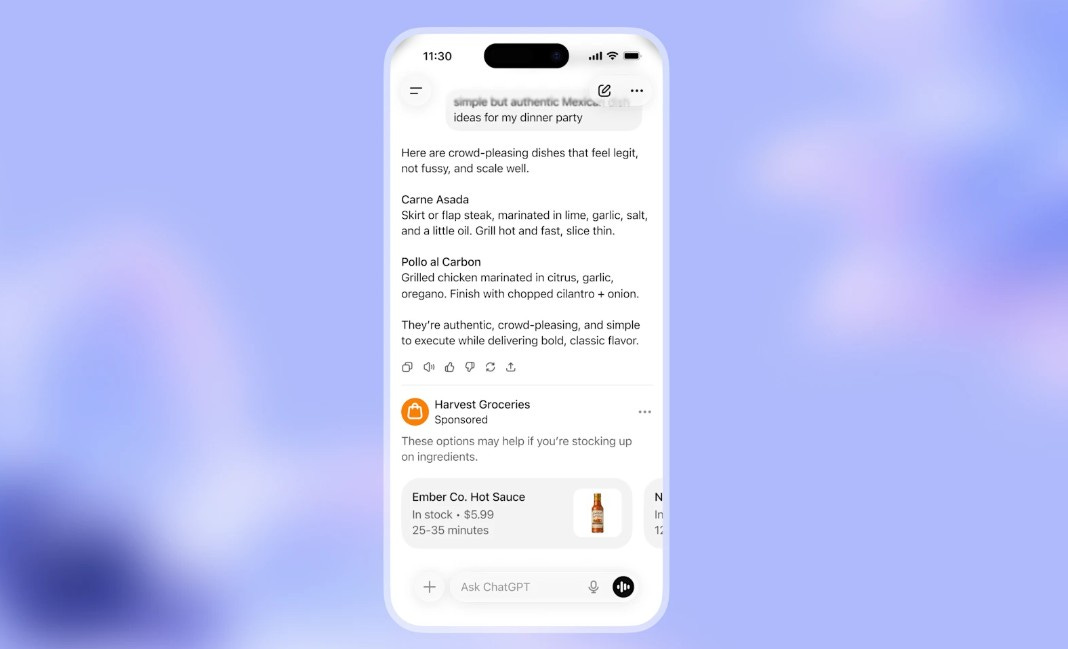
This is the correct approach because it separates a helpful response from a paid one, and doesn’t interrupt the user experience.
There’s more to ChatGPT ads than just invocation
ChatGPT’s real source of power is invocation.
To use an advertising phrase, “targeting” shifts from who you are and what you want, to what you’re dealing with right now. It means that ChatGPT won’t just prioritise which app gets invoked, it will also decide when an app doesn’t get invoked.
How will ads actually be decided? If we bring the same “jobs to be done” framework that I explained for apps to advertising, because, as Sam Altman said, ads need to be useful. User conversations help ChatGPT understand intent, and hence control advertisement invocation.
But the platform can do more than just invoking an advertisement: it can enable conversations with brands. Once an ad is invoked, ChatGPT can turn it into an interaction:
“Conversational interfaces create possibilities for people to go beyond static messages and links. For example, soon you might see an ad and be able to directly ask the questions you need to make a purchase decision.”
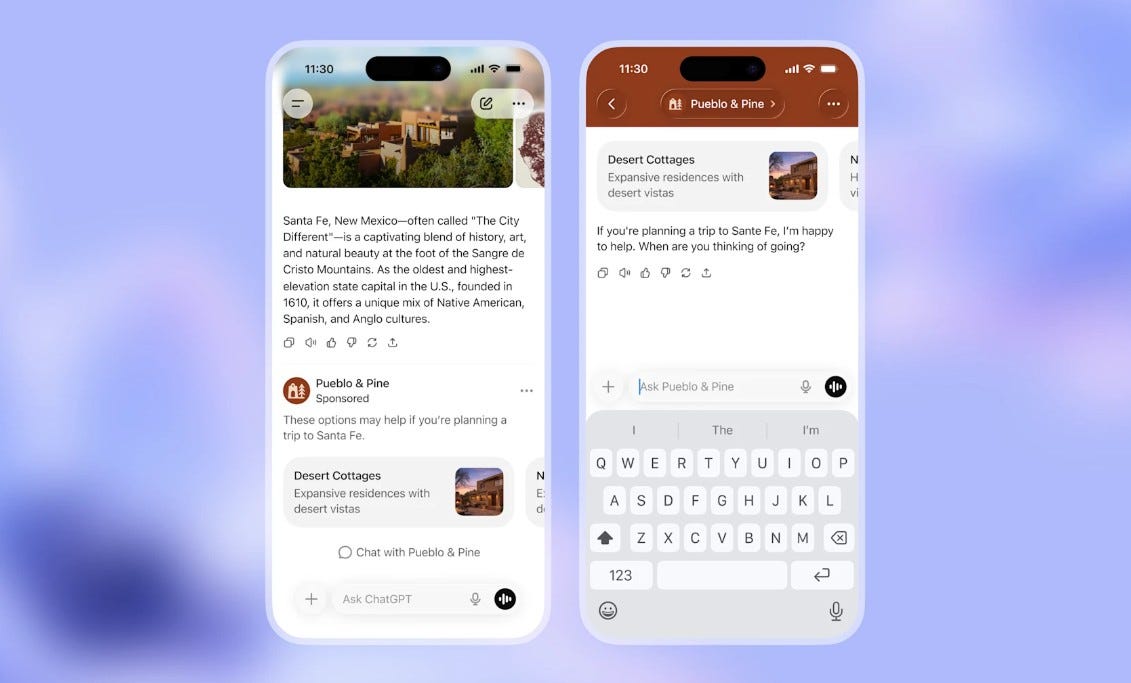
This also looks like it might target a Meta business: chats with brands is a Whatsapp for business feature, and I wouldn’t be surprised if AI chats (and not just transactional experiences) are a part of Whatsapp’s roadmap with Meta AI.
Conversations with brands are such a powerful opportunity for chat applications.
Why advertising can’t be limited to “jobs to be done”
FMCG brands, which are the largest advertisers in the world, cannot be invoked for a conversation. You won’t discuss a toothpaste with Colgate within a chat window where you’re discussing a packing list for a trip.
As I’d said in case of ChatGPT apps, the problem is that:
“When apps in ChatGPT exist to serve tasks, the real question is: who decides which app appears, and when?”
“Unless a user specifically asks for the app in the chat, the control over the app inside ChatGPT lies with ChatGPT.”
“To put it simply, it is the selector, the umpire, the ground, the conditions and potential future opposing team, all at the same time.”
Jobs-to-be-done advertising can only be invoked where a job can be executed, like in case of travel, fintech, payments, SaaS. Even those apps will look terribly limited compared to when they’re available on a platform they own. This redefines what advertising is for, and restricts advertisers to the framework that ChatGPT imposes on them. This would not just limit ChatGPT’s ability to earn, it would also limit utility to a limited proposition.
This calls for a different format, and expectedly, ChatGPT is departing from its “utility” narrative and doing this. OpenAI says:
“The best ads are useful, entertaining, and help people discover new products and services.”
“Given what AI can do, we’re excited to develop new experiences over time that people find more helpful and relevant than any other ads.”
There was no way that ChatGPT was going to limit advertising to jobs to be done, the way it is limiting apps: there’s too much money on offer.
Price for invocation and showing of FMCG ads will probably be determined on estimated invocation opportunity and competition: a marketplace-driven, largely opaque, price discovery mechanism like with Google Adwords and Facebook for Business.
Brands will probably pay per invocation, and perhaps a premium for enabling conversation.
The missing piece in OpenAI’s advertising puzzle
A system which captures intent, demographic data, psychographic information and inferred wants, is probably the most powerful advertising engine that can exist.
Unlike Meta’s platforms, and to a very small extent, Google, ChatGPT does not sit inside a network of relationships. It does not know who you are connected to, who you trust, who influences you, or which communities you belong to. It sees intent and interaction in isolation, not in relation to other people.
Advertising inside ChatGPT doesn’t have a social graph to ride on.
That distinction matters far more for advertising than it first appears. The social graph isn’t as much about identity as it is about contextual signals. Meta’s advantage has never just been that it knows what you like. It knows who around you likes what, how opinions spread, and how behaviour changes in groups.
Advertising on Meta works not only because of individual targeting, but because it exploits social proof, imitation, and network effects. This makes Meta’s position vs ChatGPT much more defensible than that of Google, because Meta combines the social graph with memory, messaging, amd commerce. Manus enables automation of that advertising infrastructure.
ChatGPT can correlate behaviour with demographic information up to a point, but doesn’t have relationships between people that emit important signals. There is a slightly flimsy attempt at “connecting people” via group chats, but that’s unlikely to be ChatGPT’s main play.
There will be a point in time when ChatGPT attempts to build a social graph, but I think its first target is Google’s intent based market.
Advertising needs attribution, not just effectiveness

The problem is that advertising doesn’t just need to work. It also needs to be explainable. At scale.
We’ve seen the panic that removal of explainability creates: The challenge that advertisers faced when Apple and Google were pushed to remove third party cookies was that precision was going to be impacted, and targeting would suffer. With decreased precision of audience targeting, startups woudn’t know “which 50%” of their ad dollars are being wasted.
Ads inside chats do not suffer from this problem, but they have other issues to deal with, with ChatGPT:
Decreased invocation, and
Opacity in decisions.
Ad agencies are accountable to advertisers, and will question why their ad is not being shown, not shown enough, or even why a competitor pops up for the CEO or brand manager, as opposed to their own brand. Advertising systems don’t just have to decide when to place an ad. They will need proof that invocation is taking place. They also have to explain themselves to people who have parked their money with them.
How will they prove that a user had a conversation with a brand, and what they said? Will user chats with brands be available to the brand? Every commercial feature-set will bring its own need for accountability to the advertiser.
Platforms first build leverage
Money brings leverage for advertisers when a platform launches advertising.
However, all platforms are built around the idea of increasing fragmentation and monetizing aggregation, such that no single entity has enough negotiating power. This is how platforms counter advertiser leverage with leverage of their own.
There’s important historical precedence in online advertising: Facebook encouraged the creation of brand pages, and companies spent millions of dollars building their presence on the platform.
One fine day, Facebook executed the rug-pull: they deprecated reach for pages, such that page owners, which included brands, have to pay to reach those who have subscribed to them.
It’s worth noting that Alphabet/Google said in a recent earnings call:
“We’ll focus on the organic experience for the near term… but over time, we’ll be able to bring very good commercial experiences there as well, and we think people will adapt to them as they’ve always done.”
The question, then, isn’t whether ChatGPT will execute this rug-pull: that is guaranteed, and in a way it is already taking place.
What I don’t understand is why OpenAI is moving so quickly after the launch of the ChatGPT App store, by rolling out advertising. Now apps and businesses, as advertisers know exactly what the rug-pull is going to be, before they become dependent on it.
Hi Nikhil, been a follower of your writing for years on twitter and now here .
Couple of points that I would like to add in this perspective.
Advertising doesn’t always follow consumer behavior. Advertising followed platforms that help the brand delay the KPI’s they are chasing. Unfortunately this is the harsh reality of current digital ecosystem. Brands look at digital advertising as top, mid and lower funnel . While the brands are conscious that consumers don’t look at advertising via the funnel, they still choose to ignore it. Let’s take example of CPG since they are the largest spenders.
CPg believes in still churning out 20 sec ads . And they know that there is a skip option in YT and on meta , people quickly scroll. But regardless of these, they still churn out 20 sec and then if one is lucky , you may get a 10 sec.
Now the consumer will skip the add on YT, so better to buy non skip . And don’t advertise on meta because who cares for a consumer who can’t even spend more than few secs on a post.
Only place where advertising follows behavior is where there are conversion campaigns. Which is where Google search , meta and now chat gpt will compete. But before it takes off, it has to address issues like attribution, data pass back for targeting, dynamic creative etc . For chat gpt to make a difference and get a large pie of advertising, they need to do what big platforms did, learn the language of a brand person and understand how they are chasing metrics. I believe this is where the social media industry lost in early part of the last decade. They had consumers, but what the social media industry didn’t have is the understanding of how the brand thinks. Reach ( or now effective reach ) rules for top funnel. And attribution for bottom funnel.