

Apple just admitted it can’t build AI
Owning the interface used to be enough. In AI, it no longer is.

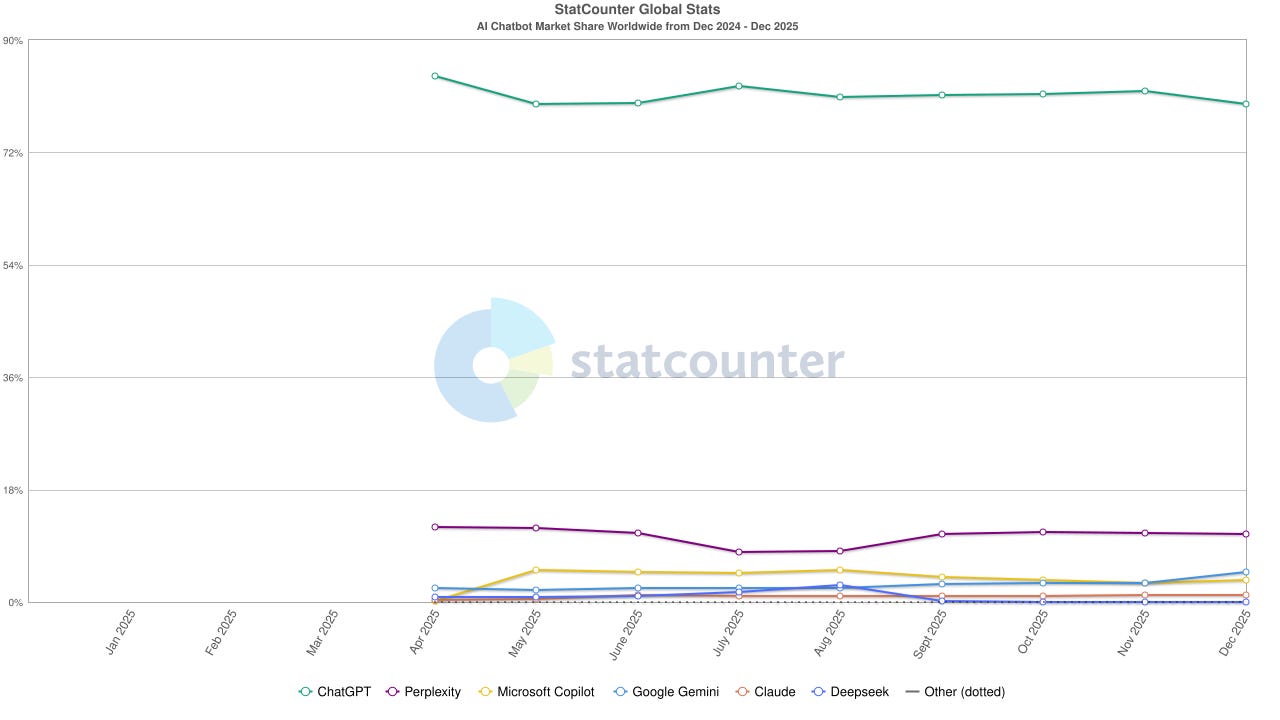
The most important chart in Generative AI is probably this, with a caveat. If you think about it in terms of web traffic, ChatGPT is miles ahead of every other AI service. You can argue that this or that Claude or Gemini model is better, but the fact is that the user has chosen.
That choice has been driven by multiple factors: ChatGPT was the first to launch, it has a distinct consumer focus and user experience (ugh at Claude’s rate limitations), and it is launching products and services (ChatGPT Health) targeting the casual user even as Claude targets the professionals. If ChatGPT had a better name it would have become a verb. Maybe it has.
On the other hand, Google is confused. Bard became Gemini. How does NotebookLM fit into all this? Why Nano Banana? But then this is what decision making by committee and diffused ownership gets you.
What this chart doesn’t show is that Gemini might actually be close to that of ChatGPT, because, like Microsoft, Google has access to ecosystem surfaces that ChatGPT doesn’t: Gmail, Android, Drive, Docs and YouTube.
A little bit of history is relevant here. In 2013, Alibaba’s UC browser was the largest mobile phone browser in India, and rapidly climbing the global charts: Google had an incumbency problem with Chrome, with no real competitor in the space. UC Browser won with a better product for that time, until Google flipped a switch: they replaced the stock Android browser with Chrome. Someone in the committee showed a glimpse of leadership and killed an internal competing product. Users got a better experience by default, including with a Google sign-in, and Chrome beat the competition. Defaults don’t need to be loved: they just need to exist.
The laziest way to think about the Apple-Google deal is to think that Google won, OpenAI lost and Apple gave up. This deal is not a public endorsement of who is going to win the AI platform battles.
First, here’s the carefully crafted statement from Google and Apple. They must have spent weeks, (and avoided using Gemini) for this:
Apple and Google have entered into a multi-year collaboration under which the next generation of Apple Foundation Models will be based on Google’s Gemini models and cloud technology. These models will help power future Apple Intelligence features, including a more personalized Siri coming this year. After careful evaluation, Apple determined that Google’s Al technology provides the most capable foundation for Apple Foundation Models and is excited about the innovative new experiences it will unlock for Apple users. Apple Intelligence will continue to run on Apple devices and Private Cloud Compute, while maintaining Apple’s industry-leading privacy standards.
Usage is a choice. Distribution is an imposition.
In the AI ecosystem wars, Google is a challenger in user-chosen AI, not in distribution. That’s why, apart from a word-salad of products, Google is focusing on integrations across the ecosystem: it is a leader in distribution and ecosystem building. Google doesn’t need users to choose Gemini. It needs Gemini to be unavoidable.
Google’s organisational confusion doesn’t prevent it from executing when it controls the surface and builds great AI models. That is also why the Apple deal, wherein Gemini will be used to power Apple Intelligence, may be a big deal: Google isn’t just adding a product integration to its ecosystem: it’s adding an entire ecosystem.
The “more personalised Siri” problem (Gruber called it first)
One of the most phenomenal pieces on the failure of Apple Intelligence was written by John Gruber last year: Something is Rotten in the State of Cupertino. It’s a long read that is worth your time.
In it, Gruber called Apple’s “more personalised Siri” vaporware, because while Apple has been promising this for a while, it is struggling to make it work, and is only showing concept videos, not demoes.
Gruber adds that “Concept videos are bullshit, and a sign of a company in disarray, if not crisis.” There was no demo of “‘personal context’, ‘onscreen awareness’, and ‘in-app actions’”. For Apple, the failure wasn’t lateness. It was overpromising on trust.
Apple probably needed to stem the damage, and if AI is going to be a key differentiator between devices, it has bought time and prevented users from migrating to Android, especially when upgrade cycles are due. If developers switch to Android because Gemini allows them better integrations, can Apple keep pace? Is Apple willing to let AI act autonomously on its platform?
Apple is actually renting credibility, to reference Grubers post, which was in shambles with Apple Intelligence. The last thing an Apple user wants is to acknowledge that Android has better implementation of features.
What exactly does Google get?
What Apple promised with the ‘more personalised Siri’ are features that Google has not only demonstrated with Gemini, but also rolled out to users.
What the joint statement doesn’t tell us:
First: How exactly are Google’s Gemini models being incorporated into Apple Foundation Models? Is this a direct licensing of models, adaptation via fine-tuning, or a co-development arrangement? Is Apple paying for API access, co-developing infrastructure, or sharing revenue?
Second: Is Google powering Apple Intelligence or just Apple Intelligence features? How will data be handled between Apple and Google systems? Is any user data processed directly by Google systems at all?
Third: What is the exact duration and scope of the “multi-year” agreement?
Apple seems to suggest that it will control the training data, because privacy is a significant selling point for Apple, as it controls the entire tech stack, unlike Android, and it’s likely that Gemini models will be available for Apple to deploy commercially to users, on top of Apple’s data.
So is Google getting money (which they don’t really need. Remember they paid Apple $20 Billion for search integration in 2022) because Apple messed up Apple Intelligence? If they’re giving money, then for what? While the statement indicates that Gemini will power Apple Intelligence, but it’s not clear whether it will have any Gemini branding at all. What is clear is that it will respond to “Siri” and not “Gemini” or “Google”. So this is different from search, where there was a clear benefit for Google. From a branding standpoint, this doesn’t look like expansion for Gemini.
If Google “won”, what exactly did they win? Did the committee decide they needed to win here in order to block OpenAI? The only thing that is clear is that they won credibility for their models and their deployment over OpenAI. Will it move up the AI usage charts as a consequence? Probably, but not in the web based traffic chart.
OpenAI’s next move
OpenAI made itself available for free in India to acquire users. Google did the same with its Jio partnership, as did Perplexity with Airtel.
OpenAI got data and users, but they don’t have an ecosystem. They are building one with ChatGPT apps, but it is still early days, and acting like control freaks might not work for them. Developers value openness more than most users.
OpenAI risks falling into the deep hole that Facebook remained in because it came late to the platform wars: Facebook never got the opportunity to own an App store, a home screen (it tried with Facebook Home) or a device (it tried but failed). They never owned an infrastructure layer (despite Free Basics trying to make Facebook the default access point for the web), which is why Apple was able to attack them on third party cookies.
Gemini might be a better model, better integrated, but ChatGPT has more users who want it. It still remains the most widely used AI product in the world, if you ignore Gemini infiltrating multiple apps and services and popping up when you least want it to. People go to ChatGPT (and Claude) with intent of using AI.
At the same time, OpenAI is winning as per the web based usage chart, while Google is collapsing discovery and with it, the open web, using AI mode. How much of ChatGPT’s user acquisition depends on Google search today?
Lastly
There’s a clear indication that ChatGPT will have to build out its own ecosystem. The existential risk for Apple is not competition from Google, but the collapse of the iOS/Android duopoly. That’s a risk for both of them. Microsoft should have never pulled the plug on the Windows Phone, but that’s another story.
The existential risk for Apple and Google is that OpenAI builds an AI first device that meaningfully disrupts iOS and Android. And it isn’t the Rabbit R1, but an evolution of it. It may start small, with a pendant, but a pendant doesn’t allow you to browse, so it’s unclear what a new device and interface for AI will look like. AI has a UX problem and voice is not enough. Maybe, just maybe, Meta is on to something with the Rayban glasses.
For Apple on the other hand, like I said, it is buying time. It had the luxury with Apple Maps for a crap product to improve over time. The battle for AI dominance is far too significant because it’s a fundamental shift.
I have little doubt that even as it deploys Gemini, Apple will work on building its own AI. Owning the interface used to be enough. In AI, it no longer is. It can’t not do this.
Very insightful read on this whole issue, especially the bit about how OpenAI will need its own ecosystem eventually. I too agree that Apple is buying time with this partnership and their failure on AI is very stark.