

How to beat the opportunity trap of the ChatGPT App Store
Own your own context, and other tips...

This is for you if you’re building apps that are planning to integrate with ChatGPT, or will eventually be forced to connect to ChatGPT.
In my last piece, I explained in detail how the ChatGPT App Store is an “Opportunity Trap”.
As a developer of a ChatGPT app, you aren’t building for users: you’re building for ChatGPT. You don’t control when your app is called, what context you get, or what comes before or after you in that chat. Apps are just one of the several tools that the model may orchestrate. You’re no longer the interface - ChatGPT is.
The ChatGPT App Store isn’t really an app store. It’s an orchestration layer. A gatekeeper. A platform deciding what gets shown, when, and how much context you get to work with. Developers lose control over user experience, discovery, branding — even whether they’re invoked at all.
AI platforms don’t just replace search. They replace choice.
The assumptions on the basis of which app developers have built multi-billion dollar businesses are no longer going to be valid, and they are being replaced with a new set of rules that AI models will determine.
You might even decide to hold off on building a ChatGPT app for now, because you don’t want to be caught in that trap. Frankly, eventually, you won’t have a choice, even if you’re a market leader.
To illustrate this problem, in July 2025, I gave the example of Zomato (disclosure: I have shares of Eternal) being forced to launch a ChatGPT app. At that time, the idea of a ChatGPT app store was hypothetical. Today it’s a reality. I wrote then:
All aggregators are in the business of increasing fragmentation and monetising aggregation in a manner that each individual entity has low negotiating power.
Rapido is the latest to enter the food delivery segment, and they’re likely to want to be the first to enter a new platform (AI) before an incumbent like Zomato or Swiggy does. It’s likely that once Rapido does this, there will be pressure on Zomato and Swiggy to follow suit… This will create new problems: there will be increased dependency on AI, which will be in a position to pick winners. When you’re ordering food, which apps will AI surface to you — Zomato, Swiggy or Rapido?
The tension at the heart of this shift is reach versus control. AI platforms will offer scale, but they will take away ownership
Now that this problem statement is clear, we know that developers developers need to optimise both for traffic and leverage, despite low bargaining power.
I know it’s early days and most people aren’t even thinking about building ChatGPT apps, but it’s probably a good idea to build leverage early, rather than grapple with it later, after network effects have kicked in. Don’t make the mistake that all those brands made 15 years ago when they put up hoardings asking people to join their Facebook page, only for Facebook to kill reach and build in a monetization model around it.
So what can you do to build some amount of leverage here?

First, Master AEO: you need to figure out AEO (AI Engine Optimisation), or GEO (Generative Engine Optimisation), as it was called until a couple of months ago. I’ve been discussing aspects of AEO for a few months with my friend Sandeep Amar, previously the CEO (Digital) for the Indian Express Digital, who works with businesses, especially news publishers, on AEO and SEO. It’s not easy, and not easily understood, but understanding around AEO for content has improved over the past year.
However, right now, we don’t know enough about how, why and when AI models recommend a particular app, and why they recommend one app over another, as well as what an app can do to improve the probability of being recommended over others. This will largely need to be reverse engineered:
By running tests to discover what triggers app invocation, to optimise app metadata and functions.
Optimise metadata and function naming in ChatGPT apps for high-frequency user intents.
Reverse-engineer prompt phrasing to align with how ChatGPT surfaces apps.
Remember that SEO is a multi-billion dollar industry, and there’s enough money for them to throw at this problem, because there will be enough money at stake here: businesses will have to pay for this problem to be solved. Algorithms will evolve to prevent people gaming them, and practices will evolve in order to game the algorithms even after they evolve.
The money in AEO lies in the gap between algorithms evolving and people learning how to game them. AEO will be to AI what SEO is to search.
Second, Build Proprietary Context: app developers will have to build and utilise proprietary context, tied to context pulled from ChatGPT (whatever it allows), but also tied to richer user data linked to a users identity, history and preferences. This way, ChatGPT becomes dependent on apps that hold proprietary context that is necessary for effective task execution. For example, Zomato can leverage your address, your order history, your preferred restaurants, your table bookings.
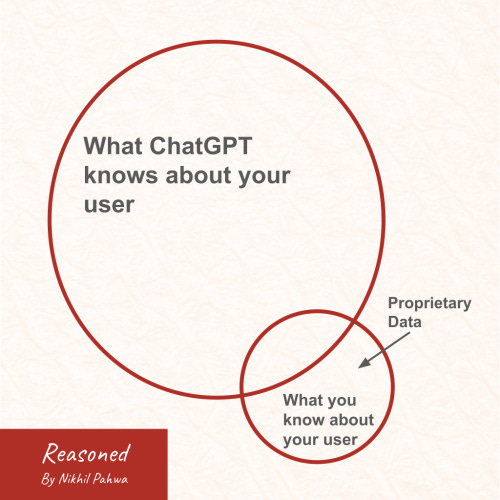
Eventually, proprietary context will be the only durable leverage apps have left. If you don’t have it, build it.
Third, Own The Fulfilment Layer: Apps need to control critical fulfilment layers, and ensure that premium functionality remains outside ChatGPT. If you can’t control discovery you must control execution.
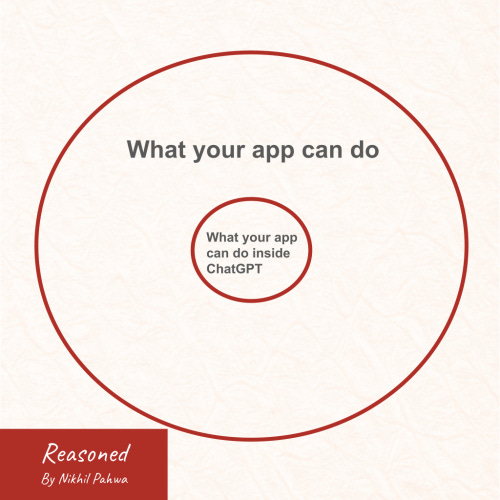
Right now, ChatGPTs Instant Checkout is limited to a few businesses, and so users have to exit the platform for closing the transaction. App developers will have to gate certain high-value outputs behind account authentication so that you can pull users on-to your platform. I may not have been satisfied by the Booking.com carousel, but the lack of understanding of my preferences and limited options in the carousel meant that I had to exit ChatGPT and go to their platform for better results.

ChatGPT isn’t allowing subscriptions for apps just yet, so premium functionality and subscriptions can still be allowed on-app. This is going to be tricky because eventually ChatGPT will prioritise keeping users on-platform, and punish applications that take users off-platform. They have far too much leverage here.
Fourth, Own A Regulated Layer: find ways of incorporating regulatory leverage: For example, I don’t think ChatGPT will be able to launch Instant Checkout in India. As a global platform trying to serve users in multiple jurisdictions, ChatGPT will prioritise where it expends its energy in compliance. The compliance in India is so ridiculously warped and restrictive that even Stripe decided to exit the country, and recurring payments fail repeatedly for users. Services and apps that involve domains with high compliance burdens such has tax filing, finance, legal, payments and healthcare are safer because ChatGPT will want to avoid regulatory risk and burdens.
This reminds me that I need to spend some time thinking about the impact of AI on Payments and Fintech).
Note: If this email landed in your Promotions tab, moving it to Primary helps.
Fifth, Create UI Dependent Tasks: figure out assets that require modifications that won’t be possible inside ChatGPT. Canva is a great example here: you can generate initial templates inside ChatGPT, but you’ll need to exit ChatGPT in order to make minute changes like changing the font, moving that text-box ever so slightly to the left. We all know how frustrating image generation using prompts can be when it comes to minute changes.
ChatGPT can generate a presentation, but it doesn’t know your brand guidelines. Canva does.
Sixth, Use Anti-Trust when the time is right: An anti-trust solution. One complaint against the Google Play Store was that it was self-preferencing its own payments app (Google Pay) in recommendations over competing apps. Google’s AI mode is also being accused of preferencing YouTube and Google platforms over others. The same problem will eventually come to AI: how it preferences some sites over others. At that moment in time, companies must seek accountability from ChatGPT, and there will eventually be calls for transparency into app invocation logic, ranking factors, and invocation frequency. Eventually, algorithmic accountability will be demanded.
This is part of an ongoing series on how AI is rewiring the Internet. I’ll keep building on this line of thinking. Subscribe if you’re finding this useful.
Seventh, incorporate brand recall and nudges: Remind users that they’re checking you inside ChatGPT. Booking.com did this well, with a bright blue “View on Booking.com” button inside ChatGPT. If they know you and your brand, and this is possible right now because there are no ChatGPT-only apps, and most apps with a ChatGPT presence have a fairly substantial off-chat presence as well, you need to subtly nudge them to your platform. This makes ChatGPT a user acquisition source, and you’re no longer a service provider to ChatGPT. If users can’t recall your brand, you become a vendor for ChatGPT.
Like I mentioned in my piece on how AI is rewiring the Internet, AI is going to mediate how users experience the web and applications. If you’re not building for that highly probable future, where a users first port of call is to ask an AI app before even thinking about opening yours, you’re not building for the future. AI is eating the web (and apps).
Your only leverage lies in building your own context, owning fulfilment and proprietary features. Everything else — discovery, design, even the interface — will eventually belong to someone else.
Just look at what Social Media and search did to the URL.
*
P.s.:
Please feel free to write in (leave a comment, email, tweet) and disagree with me. It helps me be less wrong.
I got a domain for Reasoned. It’s at reasoned.live. Now to figure out what to do with it, apart from redirecting it to this substack.
Version 1 of the Reasoned thesis: Reasoned exists to track how AI is changing the Internet’s underlying structure — not just products, but power, incentives, and leverage. I’m writing this for people who build, create, market or own things online, and need to understand which assumptions are breaking before those changes harden into new defaults.
This made me realy think. So developers are just tools, then?