

From “There’s an App for that” to “There’s an App for me”
Everything you want, everything you need.

Quite note: I’m at the AI Summit in New Delhi this week, and Chairing a Session on AI, Open Source and Sovereignty. If you’re working in AI in Advertising, Education, Health, Films, Music, Defense, Finance, Commerce, or on Agents: would love to speak during or after the Summit. In a couple of weeks, I’ll open up time-slots for conversations.
—
App 1: A few days ago, I asked Claude Code to create an RSS feed reader that has three separate homepages: one for AI, one for Tech Policy, and another for Indian Startups: the three areas I focus on for work. It resides on my device, pulls data through RSS feeds I’ve subscribed to, and there are three mini prioritisation algorithms I’ve added, that use AI API to sort the links. I’m adding a Manchester United page next.
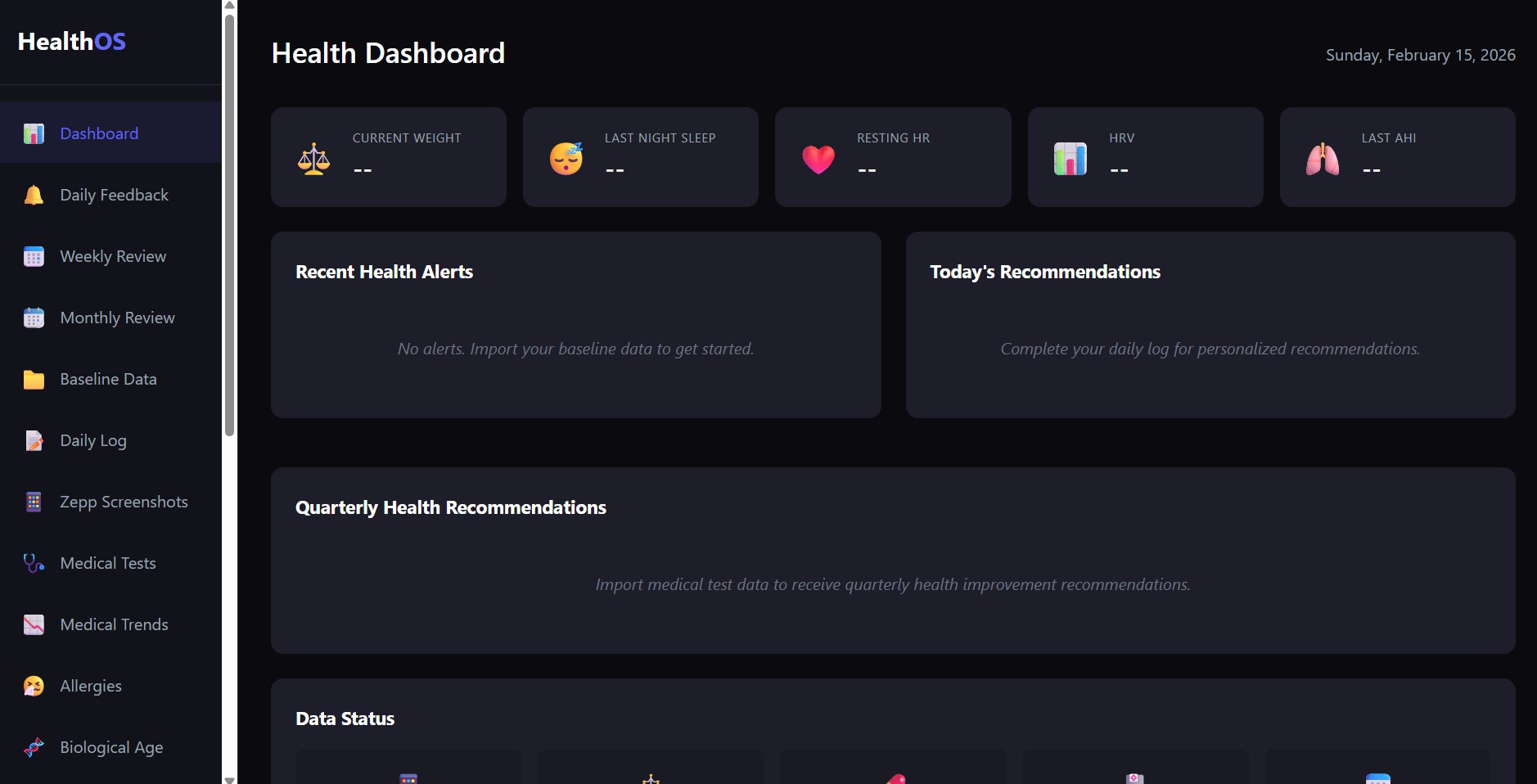
App 2: It took a few hours, but I’ve built a custom app for my health data. My Amazfit Helios Strap contains a lot of data, but I don’t really want to pay for the AI subscription. The same app takes data from my blood test reports and charts them, and analyses it using OpenAI API. I really don’t want to give this data to a mass market app.
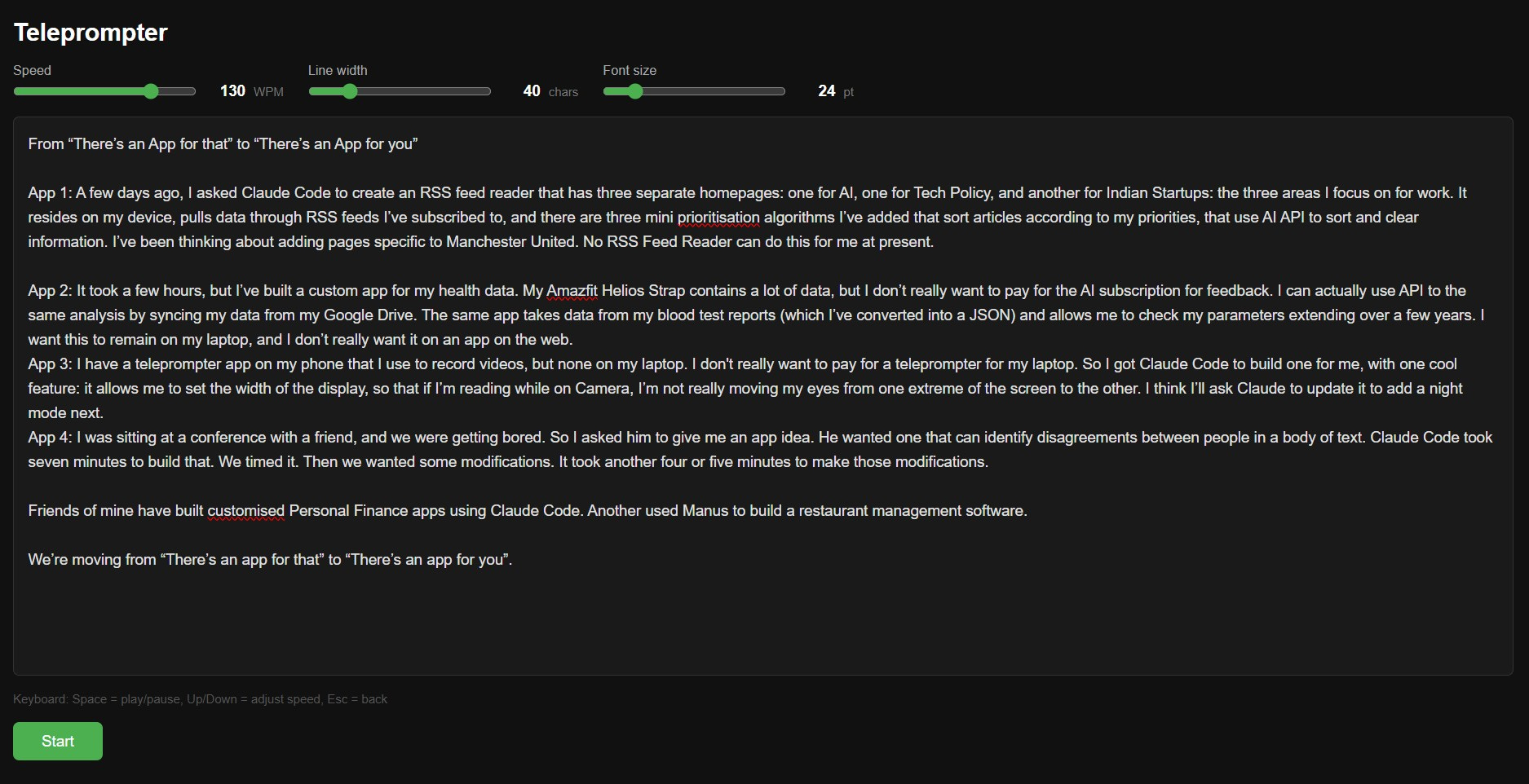
App 3: I have a teleprompter app on my phone for when I record videos, but none on my laptop. I didn’t want to pay separately for that, so I got Claude Code to build it, with an additional feature that allows me to set the width of the display.
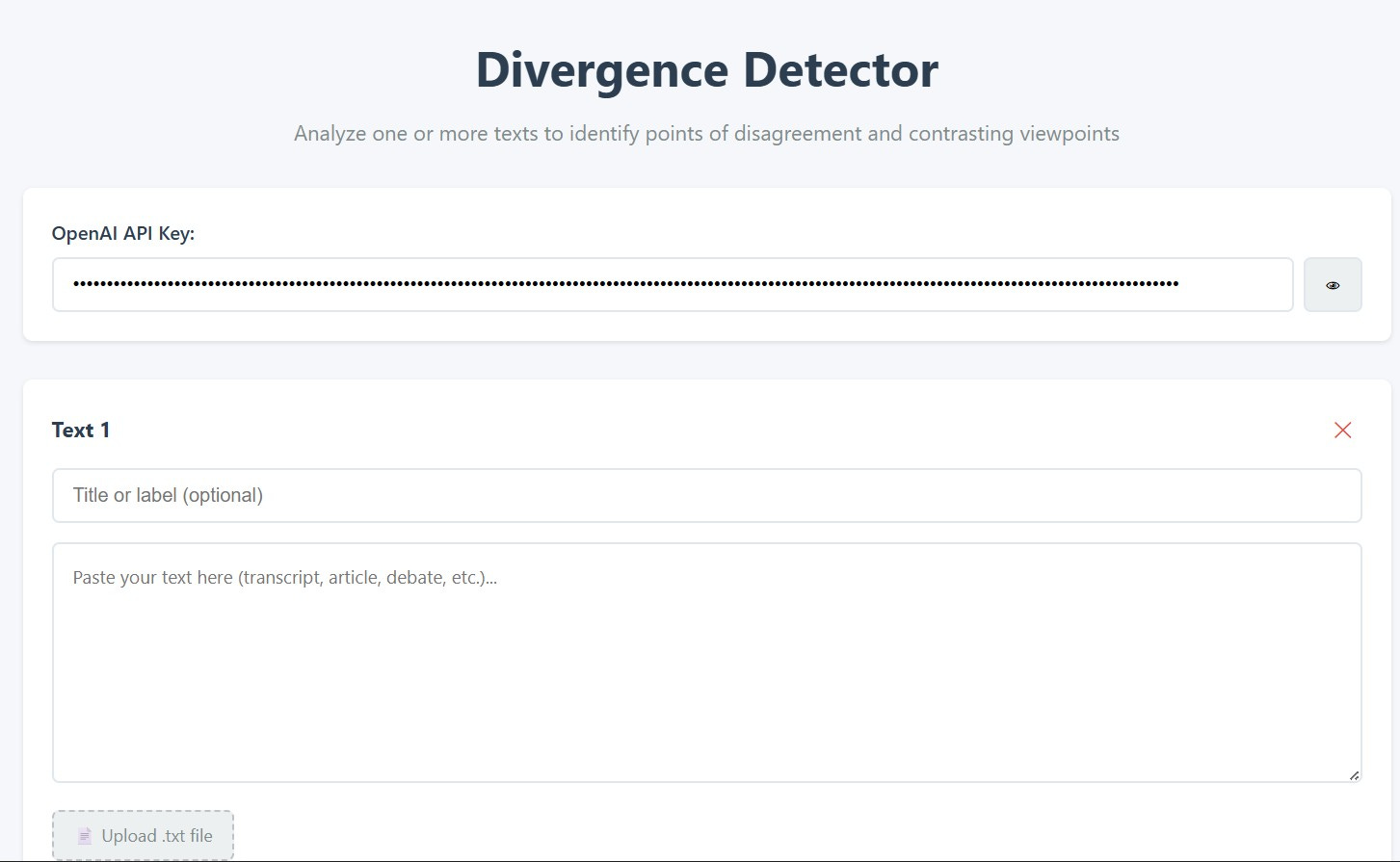
App 4: I was sitting at a conference with a friend, getting bored, so I asked him to give me a simple app idea. Claude Code took seven minutes to build that app, which identifies disagreements between people from the text provided. It took three minutes to make some modifications.
Friends of mine have built customised Personal Finance apps, their own health apps, and even a restaurant menu and ordering tool using AI.
We’re moving from “There’s an app for that” to “There’s an app for you”.
Why the personalisation of apps is here to stay
There’s always something about an app that doesn’t quite feel complete. Once you’ve used AI to build something for yourself, you notice how quick and easy it is to build exactly what YOU want.
Sometimes when you don’t want to pay for a particular app, you try and create it for yourself: you’re already paying AI services, it doesn’t take very long, and sometimes it’s just fun to build something exactly how you would want it. Sometimes you build an app just for the heck of it, because you wonder if it’s possible.
The app economy was never designed around your exact preferences: it was designed for scale. For a large app to be built, it needs cloud infrastructure, clean code without bugs, so the app doesn’t crash. It needs to make money, to pay for both development, maintenance and improvements. It needs marketing to acquire users at scale, to enable monetization via ads, subscription or to enable the apps acquisition.
When building software is expensive, you need a big enough market.
Features that appeal to a larger number get prioritised. Generic “personalisation” features always stop short of someone’s real workflow, because granular, individualistic specificity doesn’t scale.
You end up with apps that are good enough for many, but never perfect for everyone.
When coding becomes cheap
This changes when the cost of coding tends towards zero.
AI services have already scraped enough code, enough of Stack Exchange, such that creating an app becomes very cheap, costing a few thousand tokens.
Additionally when apps get coded at AI speed, they stop being things you search for: They appear when you need them.
We’ve seen this happen with Claude Code, wherein it codes artifacts in order to complete a task. If you give it financial data and ask for an analysis, it codes an artifact that has visualisations. OpenClaw has been known to create apps on its own when given the task of growing a users YouTube Channel, or create a Kanban board to track its own tasks in real time.
The AI here is focused on outcomes, and if there’s an app needed to be built to achieve that outcome, it builds it.
Some issues remain with personalised apps, though: Coding costs tend toward zero, but other costs remain. I won’t put a vibe-coded app on a server—unknown security vulnerabilities could leak my health data. I’m not even sure if it is entirely safe on device. A friend has deployed his on the cloud, but he knows how to use AI to check for security vulnerabilities.
Reliability is a major issue. The teleprompter burned tens of thousands of tokens before getting adjustable speed right. The health app kept skipping datasets. But you overlook flaws when it’s this cheap and fast. Sometimes you create an app just because you had an idea.
For enterprises, vibe-coded CRMs can’t replace enterprise grade options. Bugs are for real. Making it consistent across device types and varying screen sizes for people on the move is also a challenge. You also don’t want to get limited to a single device.
So when coding becomes cheap, two things happen: personalised tools become viable, and the app economy splits into what can be commodified versus what requires trust, maintenance, and coordination at scale.
When the market of one makes sense: I want it that way
I’ve lost count of the number of “Read it later” and “To-Do” apps that have appeared on the Productivity Apps subreddit over the past six months. Before I realised what was going on, I even paid for one.
When you mostly have to give screenshots, a design and workflow logic and a tool will code it for you as long as you can define functionality well enough, the market value of apps that can be commodified will plummet. For some apps, their idea is now a screenshot and prompt away from being replicated. Their discovery now depends on standing out among several apps that look similar with similar marketing pitches.
For developers: graphic design, UI, automation ( I haven’t explored it, but someone tweeted this list of Public APIs), and basic functionality all now trend toward cheap. Intelligence and analysis is commodified with access to AI APIs. Simple utilities like alarm clocks, calculators, translators, teleprompters are all commodity now.
Newsreader apps like Flipboard, Instapaper or Pulse were limited by the need for a broader market. This led to the feature stuffing, averaged out user needs, in order to optimise for the scale needed for revenue.
I need an app that gets things done for me: for the market of one.
For users, workflows are inherently personal. Personalised apps make sense when you want to experiment with a idea (teleprompter), want to keep the input/output private (health, personal finance), or if you don’t need to work with anyone else using the app (messaging/Slack), don’t want to pay, don’t want complexity (a feature, not an app), or can tolerate an imperfect output and the cost of failure is low.
If it’s good enough for me, it’s good enough.
In addition, many needs are ephemeral, and it’s just that we never considered building a temp app for them. The easiest subscriptions to cancel are the ones you only needed once.
Claude Code might build a temp app for me to analyse Disney’s Q4 financial results, but I don’t need it again after that. This is when we move from apps to orchestration, and from outputs to outcomes.
At the same time, some sets of apps will still be secure:
First, something that connects online to offline, because of its own complexities. I don’t expect anyone to vibe-code an ecommerce business, or a food delivery app just yet. The offline connect is defensible because of its complexity.
Second, for digital-only apps, anything that is regulated still remains defensible: payments and medicine ordering apps.
Third, SaaS will evolve, not die. Organizations have bureaucracies that resist change. Enterprise-grade apps depend on a deep understanding of a clients internal workflow and its complexities: workforce management, task tracking, CRM, and the need for data security. People trained on a software don’t want to be trained on new ones: they just want to do their work. Lastly, their tolerance for probabilistic outputs with bugs is much lower than a guy who’s trying to build a hobby app.
Fourth, are social apps, even if they’re optimising for AI generated content, address a need for connectivity, even if an app for a daily (hourly?) dopamine fix can be vibe-coded.
Markets of one fail when you need high trust, high stakes, multi-user coordination, compliance, bureaucracy, or long-term support.
The impact of “There’s an app for you”
Still, there’s a repricing coming to the app economy once personalisation of apps goes mainstream, and beyond developers.
One, the impact is on pricing. Easily substitutable apps get commoditised and lose market, unless maybe they restrict export of user data, or have a great degree of algorithmic personalisation. Once you’ve trained ChatGPT on your patterns, moving to Gemini means starting over, even if GPT-5.2 makes you want to punch it in the face. Daily. Personalisation creates stickiness.
Two, app stores stop becoming the only (primary?) distributors of apps. There will be further pressure on app stores to stop playing gatekeeper, and the monopolistic OS+App Store construct will weaken further.
Three, a marketplace for blueprints for apps will emerge, because a clear enough instruction allows for an app to be created. You don’t need to sell code. Just the recipe: an idea and its implementation schema. Two corollaries: First, someone needs to build trust marks for blueprints—security vulnerabilities are inevitable. Second, a marketplace for upgrades will emerge: paid features or improved versions with more functionality.
Four, AI orchestration apps gain power when have to search and select tools, and can just build. However, they need to make production simpler, faster and more mass market (I don’t care how the mutton seekh kebab is made). Someone should package coding, UI/UX feedback automation, security and maybe even hosting together.
Five, price of apps in the defensible categories (above) will be impacted because competition will increase in these categories.
Six, there might be a marketplace for support, because AI coding delivers imperfect outcomes. We’ve already seen that there are people making money helping users install and secure OpenClaw. There might even be maintenance subscriptions.
Seven, a marketplace for reliable connectors emerges: plug-and-play integrations for your custom apps. AI forces interoperability. Many apps are still closed, and will face interoperability pressure from users.
Eight, legal enforcement will increase, as apps move to prevent or restrict cloning: watermarking, anti-scraping terms, clone takedowns, and tighter platform policies become part of the competitive toolkit.
Nine, and this is my favorite: there will be no market for monthly/annual subscriptions for many commodity apps. You don’t even need a lifetime deal when you can just build that app.
Ten, what happens when a device gets stolen? What happens when you have to change devices? A market for custom apps backup and restore services will emerge, or become a part of AI tools.
Did I miss anything? Leave a comment if you have more ideas or disagree with any of these.
The future will be hybrid
I’ve been thinking about what the perfect interface will be in the future. I even have a piece written out about what an Agentic OS will be like, but I’m not very happy with it for now. It’s marinating. A few things:
One, OpenClaw promises that it works while you sit on a beach sipping a drink, but we are not comfortable with everything becoming orchestration either.
Two, while we don’t just want outcomes, and we don’t want to do all the work, and we also want visibility over what’s going on, and thinking surfaces. We want to see outputs that make us think: dashboards, charts, newsfeeds. Discovery and connecting dots is iterative. Outputs are often indeterminate but necessary: sometimes outputs are the outcome.
Three, we don’t just want all apps to be personalised: ephemeral tools are great for one-off outcomes, but for repeat outcomes and use cases, we want persistence, and networked outputs/outcomes to remain. We want social discovery, social connections and YouTube.
Four, it also won’t just be a set of apps on a home screen: that still persists, but it’s not an end state.
So what’s the perfect interface?
It’s not one OR the other: it’s AND. The default has to have an assistant that acts autonomously, where you have access to personal apps and dashboards, and a global set of apps. It’s not orchestration OR apps, personalised OR global: it’s orchestration AND apps, personalised AND global.
With time, one layer will dominate the others, but as long as human needs don’t change, any interface that has only one will be insufficient.
same thesis, different angles. you're mapping where value goes, market of one, personalized apps.my mapping is where value leaves, horizontal SaaS, commodity vendors. punchline is identical: commodifiable collapses, defensible survives. v1 is free, v47 is the moat.